
AI and Customer Service: Why Human-Machine Collaboration Outperforms Full Automation

Artificial intelligence doesn't replace customer service agents. It transforms them into experience architects. The companies achieving the highest customer satisfaction aren't the ones automating the most, but the ones deploying AI to amplify human capabilities while giving customers the choice of how they interact. McKinsey estimates that applying generative AI to customer support functions can increase productivity by 30 to 45% in value. But that productivity only fully materializes when humans remain at the center of the system.
The knee-jerk reaction of many companies facing support volume growth is to place a chatbot on the front line, impose an automated journey, and relegate human agents to a safety net role. This approach produces a paradoxical result: customer drop-off rates increase, complex cases pile up with underprepared agents, and overall satisfaction stagnates or declines.
The real question isn't "how many tickets can we automate?" but "how can AI make every interaction, human or automated, faster, more relevant, and more satisfying?"
The Systematic Automation Trap
Automating simple tasks seems logical. In reality, this strategy creates a well-documented perverse effect: when AI absorbs easy requests, human agents are left exclusively dealing with difficult cases. Cognitive load increases, task diversity disappears, and burnout risk rises. CX specialists call this the automation paradox in customer service: simplifying the overall workflow can make daily life harder for the people who remain.
This problem intensifies when companies impose the AI channel with no alternative. A customer with a pointed technical question, who's stressed by an urgent situation (lost connectivity abroad, payment issue), or who doesn't master conversational interfaces gets trapped in a journey that doesn't meet their needs. They drop off. And in most cases, they don't come back.
High-performing companies understand that the concept of service implies choice. Offering simultaneously an AI path for simple requests and direct access to a human agent for everything else isn't a luxury. It's the minimum required to respect the diversity of user profiles.
AI as Copilot, Not Replacement
AI's value in customer service doesn't lie in conversations with end customers. It lies in the invisible optimization of agent work.
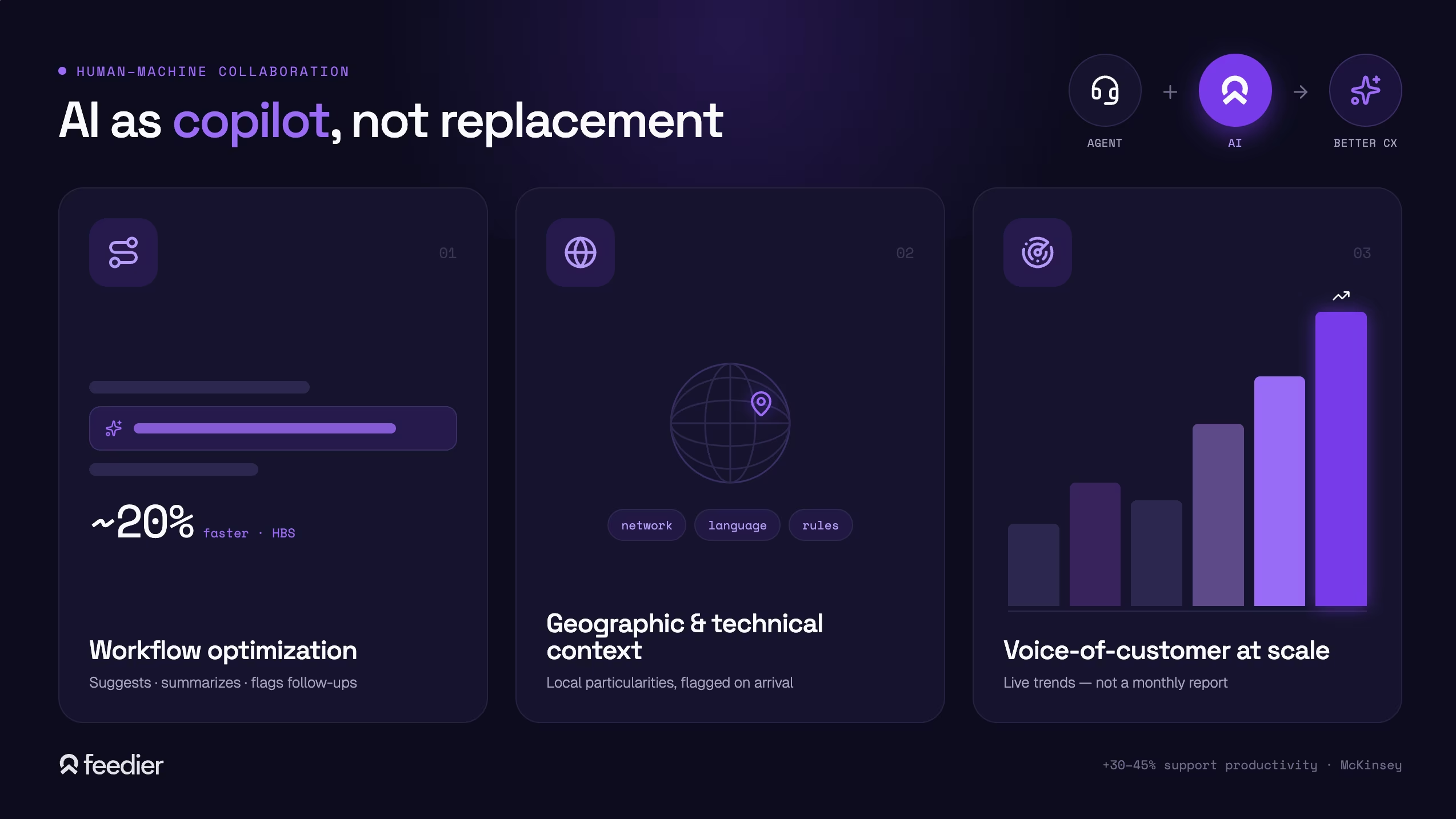
Three domains illustrate this complementarity:
- Workflow optimization. AI audits an agent's journey in real time: how many clicks to resolve a case, which information is redundant, where bottlenecks occur. Research from Harvard Business School showed that AI enabled human agents to respond roughly 20% faster, with even greater gains for less experienced agents. The tool suggests responses, summarizes past interactions, and flags necessary follow-ups.
- Geographic and technical contextualization. When a case arrives from a specific country, AI alerts the agent to local particularities (network configuration, preferred language, regulations). This reduces diagnosis time and eliminates unnecessary back-and-forth with customers.
- Voice-of-customer analysis at scale. The thousands of tickets that come in each week contain weak signals invisible to the naked eye. AI categorizes, prioritizes, and surfaces emerging trends to product and marketing in real time, not during a monthly report. This "talk to your data" capability transforms care into a permanent strategic sensor.
Proactive Recovery: Reaching the Customer Before They Leave
One of the most powerful applications of human-AI complementarity is proactive recovery. The principle is simple: when AI detects that a customer in an automated journey hasn't responded for over a minute, a human agent steps in to offer help. This fluid handoff from bot to human prevents silent customer loss.
This approach rests on a frequently ignored assumption: a customer who contacts support is giving the brand a second chance. Studies show that over 50% of dissatisfied customers never contact customer service at all. They leave silently. Those who make the effort to reach out represent a high-potential retention population, provided the interaction meets their expectations.
Proactive recovery goes even further. Some companies use AI to detect system-side incidents (network outage, billing error) and contact the customer before they've even noticed the problem. This anticipation produces what customers describe as the best possible experience: not having to contact support and being proactively reached out to.
Agent Empowerment: The Hidden Key to Performance
The least publicized yet most decisive topic is AI's impact on agent empowerment. In the traditional model, care is the "poor cousin" of the enterprise. Agents perform repetitive tasks, have zero visibility into the impact of their work, and leave the company within 18 months on average.
AI reverses this dynamic when deployed correctly. Agents are no longer mere executors: they become the AI's coaches. They're the domain specialists who identify conversational AI errors, suggest wording improvements, and validate responses before production deployment. This responsibility transforms the role.
The impact on retention is spectacular. Companies adopting this empowerment model see near-zero attrition in their care teams, even beyond the critical 18-month threshold. The mechanism is logical: an agent who sees their feedback integrated into the product, who can communicate directly with a developer or marketing lead, who knows their escalation triggered a visible change in the application, has no reason to leave.
This creates a virtuous cycle. Experienced, engaged agents train better agents. Organizational knowledge transfers organically. And AI, fed by quality feedback, improves continuously. McKinsey confirms this in their report Building Trust: How Customer Care Leaders Pull Ahead with AI: care leaders invest in technology AND talent, never in one at the expense of the other.
The Inverted Pyramid: When Agents Drive the Company
The most advanced model of this complementarity is what some organizations call "flipping the pyramid." In a traditional structure, management gives instructions that cascade down to agents. In an inverted structure, agents, in direct contact with customers, push information upward and trigger actions.
This reversal isn't symbolic. It's operational. The agent who detects a recurring bug reports it directly to the technical team. The agent who identifies a recurring misunderstanding about pricing alerts marketing. The agent who notices an onboarding flow generating friction flags product. AI facilitates this process by structuring and prioritizing escalations, but humans remain the first-line sensor.
This model also transforms recruitment. The profiles sought are no longer ticket operators but professionals with critical thinking, curiosity, and analytical capability. AI makes non-technical profiles autonomous on tasks that previously required developer skills. A head of customer operations can now build proofs of concept, automate workflows, and analyze massive datasets, all through accessible AI tools. The role increasingly resembles that of an intelligence architect, capable of refocusing every position on its true value contribution.
Deploying AI with Discernment: The 100% Rule
The final question isn't "should we use AI?" but "on which specific cases do I have 100% confidence in the quality of the automated response?" If the answer is yes, AI can handle that case. If any doubt remains, a human must be present.
This 100% rule is demanding. It prevents hasty deployment of chatbots on poorly understood topics. It forces the company to invest in the knowledge base, in training data quality, in continuous agent feedback. But it's precisely this rigor that ensures when AI is deployed, it reaches a quality level that reinforces (rather than erodes) customer trust.
Companies applying this philosophy aren't trying to replace humans with machines. They're building a system where the machine makes the human better, and the human makes the machine more reliable. It's this virtuous loop, not brute automation, that produces lasting results in customer satisfaction.
Level 4? You're Level 2
Get the Five Levels of Voice of Customer Maturity

Our articles for further exploration
A selection of resources to inform your CX decisions and share the approaches we develop with our clients.