GetFeedback alternatives: 5 real options before the December 31, 2026 shutdown

GetFeedback Direct shuts down on December 31, 2026. SurveyMonkey, which has owned GetFeedback since 2019, confirmed the date on its own product page and is steering customers toward SurveyMonkey Enterprise. If your NPS, CSAT, or CES program runs through GetFeedback's email or Salesforce surveys, you are choosing a GetFeedback alternative this year whether you planned to or not.
Here is the one-line answer before the detail. If you want the least disruptive move, SurveyMonkey Enterprise is the official path and comes with migration support. If you want to come out of this migration with a better program than you went in with, look at platforms that upgrade the analysis layer, not just the survey forms. That second option is where Feedier sits, and yes, this is Feedier's blog, so judge the arguments on their merits.
Most guides ranking for this search treat the shutdown as a survey-tool swap. That framing misses the bigger decision: you are also deciding what happens to years of accumulated feedback data, and whether your next platform just collects responses or actually analyzes them.
What is shutting down, and what is not
Two products share the GetFeedback name, and only one is closing.
GetFeedback Direct is the survey product Salesforce teams used for transactional and relational programs: email surveys, Salesforce-triggered sends, responses mapped to Salesforce records. That is the product retiring on December 31, 2026.
GetFeedback Digital, the website and in-app feedback product that started life as Usabilla, continues. SurveyMonkey renamed it simply "GetFeedback" and relaunched it with a self-serve website feedback tier in June 2026. If you only use the on-page feedback widgets, this deadline is not yours.
Three more facts frame the decision. First, SurveyMonkey's recommended transition to SurveyMonkey Enterprise takes about 90 days under its own published guidance, run with a dedicated Technical Solutions Manager, with data migration services for US customers and manual rebuild support for priority surveys elsewhere. Count backward from December 31 and the comfortable start window closes around the end of September. Second, SurveyMonkey has not publicly committed to retaining customer data after the shutdown, so every serious migration guide says the same thing: export your full response history now, before you do anything else. Third, this is not an isolated event. Qualtrics is sunsetting Delighted on June 30, 2026, as Salesforce Ben covered in detail.
The simple, affordable feedback tool tier is being consolidated into enterprise suites, and the migration path a vendor offers is not automatically the one that fits.
What GetFeedback reviews tell you to look for in a replacement
Read through GetFeedback reviews and the AppExchange history and the same three strengths repeat. The Salesforce integration was native: responses landed on Contact and Case records and triggered workflows without middleware. CX managers could edit surveys themselves without filing admin tickets. And the product stayed simple where enterprise suites got heavy.
That list is your evaluation rubric, and it works in the other direction too. Write down which GetFeedback features your team never touched, because you are about to be sold their enterprise equivalents at enterprise prices. The admin-dependency question deserves its own test: in every demo, ask the vendor to let your CX manager, not their solutions engineer, change a survey question and confirm the Salesforce mapping survives the edit. That single test would have predicted most of the frustration threads in GetFeedback's later reviews.
GetFeedback pricing: the anchor you do not have
GetFeedback pricing was quote-based, which leaves most migrating teams without a public number to benchmark replacements against. Dig out your current contract before any sales call, because it is the only anchor you own. Where a replacement vendor publishes its prices, treat that as a point in its favor: it means the number will not move depending on how your procurement team dresses.
The 5 best GetFeedback alternatives and competitors for 2026
1. Feedier
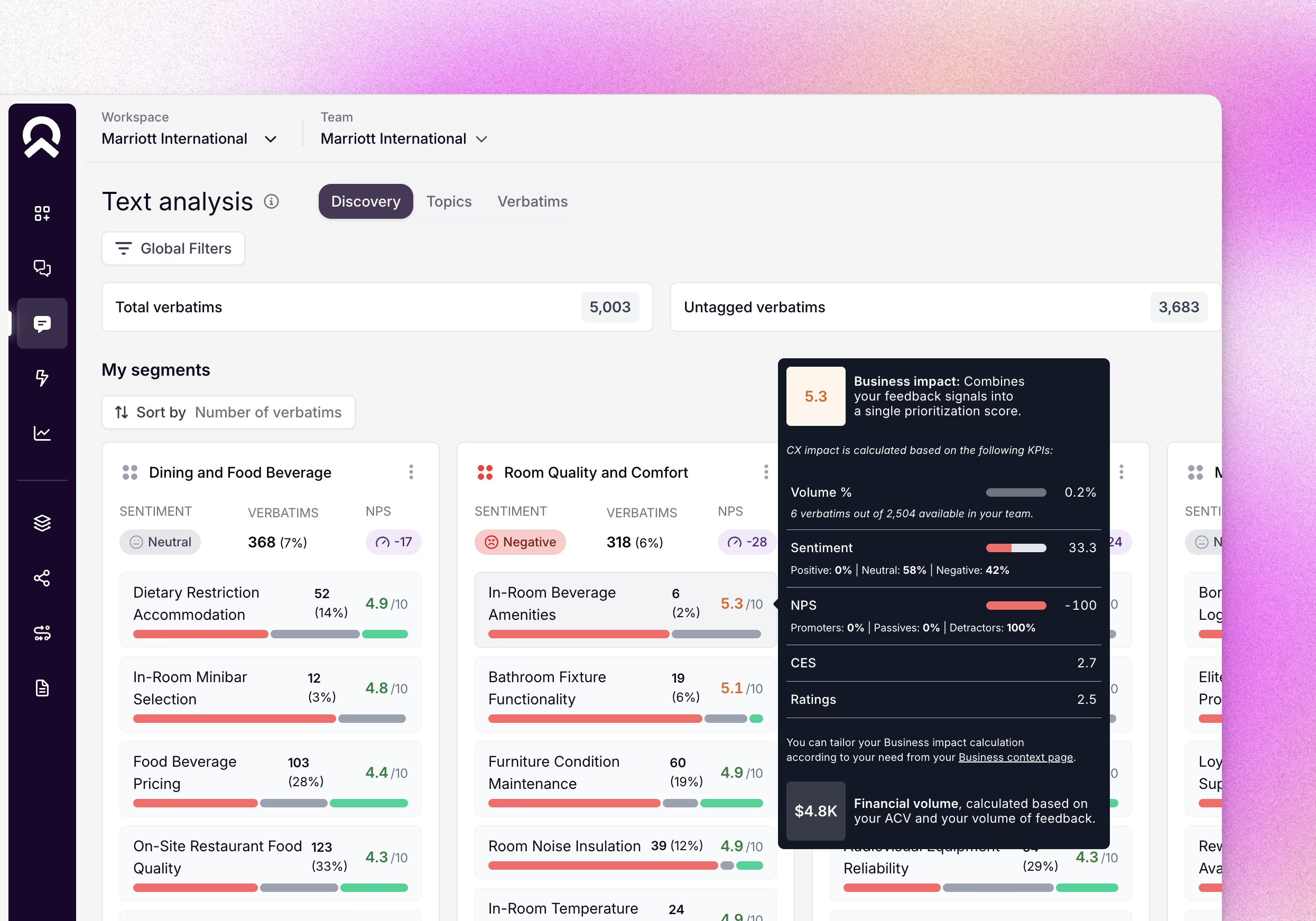
Feedier is a customer intelligence platform, not a survey tool that added dashboards. It centralizes feedback from surveys, review sites, and support tickets into one platform, then uses AI to categorize the verbatims, score sentiment, and surface what actually drives your NPS and CSAT movement. For a GetFeedback team, the pitch is blunt: you have years of open-ended responses that were collected and barely analyzed. The migration is your one natural chance to fix that.
The Salesforce mechanics matter here, so to be precise about them: Feedier connects to Salesforce through its integrations layer. You can trigger surveys by email or SMS from CRM events, enrich each piece of feedback with business attributes from your CRM or ERP, and sync analyzed feedback back into Salesforce for account teams. Feedier's integrations team also builds custom connectors when your stack includes something non-standard, with a scoped test environment before release.
And Feedier publishes starting prices, which is rare in this category: Start at $15,000 per year, Standard at $25,000, Advanced at $42,500, all with unlimited feedback sources, themes, action plans, and reports. Data import is handled by Feedier's team from the Standard plan up, which for a migration year is not a small detail.
The methodology behind the product comes from more than 100 CX projects run by Feedier's customer success team, and the customer list includes programs like Aéroport Nice Côte d'Azur, which won a CX Awards Silver for its voice and AI customer listening program, and Money Advice Trust in the UK.
Now the honest limitation. Feedier is not a Salesforce-native AppExchange app. Your surveys and analysis live in Feedier and connect to Salesforce; they do not run inside it. If your requirement is literally "everything happens inside Salesforce," pick a native tool from this list. And at a $15,000 entry point, Feedier is built for structured voice of customer programs, not as a like-for-like replacement for a small survey subscription. If you are spending less than that on your whole feedback stack today, the tools below will fit better.
2. SurveyMonkey Enterprise
The official migration path, and for some teams the right one. SurveyMonkey Enterprise brings mature survey logic, broad distribution, a large integration catalog, and the operational comfort of being guided by the vendor that set the deadline. The 90-day supported transition with a dedicated Technical Solutions Manager is real value if your team has no bandwidth for a self-run migration, and US customers get data migration services included.
The trade-off is the one every independent migration guide flags: SurveyMonkey Enterprise connects to Salesforce through a connector rather than the native architecture GetFeedback Direct was built on. Your field mappings, triggers, and case-creation logic get rebuilt, not transferred. You end up on a bigger general-purpose survey platform, with the Salesforce behavior that made you choose GetFeedback approximated rather than replicated. Pricing is quote-based. Pick it if continuity beats everything else and your Salesforce workflows are simple enough to rebuild and validate quickly.
3. Qualtrics

Qualtrics is the move for organizations treating the shutdown as a reason to consolidate onto a full experience management suite. Program governance, research-grade methodology, advanced statistics, and multi-country scale are genuinely stronger than anything GetFeedback offered. If you are weighing GetFeedback vs Qualtrics directly, the one-line answer: Qualtrics does far more, at far higher cost and complexity.
The cost part is measurable. Qualtrics publishes one price, a $420 per month self-serve research plan, and everything a CX team would actually deploy is quote-based; Vendr's contract data puts the median annual spend around $28,500. There is also a pattern worth noticing before you sign: Qualtrics is the company currently sunsetting Delighted, the simple feedback tool it acquired, to move those customers onto the full platform. Consolidation cuts both ways. We wrote a complete guide to Qualtrics alternatives and competitors if that evaluation is on your list.
4. Zonka Feedback

Zonka Feedback is positioning hard for exactly this migration, and its published material is specific: bidirectional Salesforce sync, AI feedback analysis, omnichannel distribution, multi-location reporting, plus historical data import and dedicated migration support. Zonka says typical GetFeedback migrations take two to six weeks, with surveys being the fast part and Salesforce automation rebuild being the slow part, which matches what other guides report.
Who should pick it: Salesforce-centric teams that want to stay survey-first, keep CX managers editing surveys without admin tickets, and move fast. The positioning read to weigh: Zonka is a feedback collection platform at its core. If your plan is to consolidate non-survey sources like app reviews and support tickets into one analysis layer, that is a different product category than the one Zonka competes in.
5. SurveyVista
SurveyVista takes the purist position: a survey tool built 100% natively on Salesforce, distributed through the AppExchange, with no external middleware at all. Responses, logic, and automation live inside your org. The company was founded in 2020, publishes a step-by-step GetFeedback migration guide, and points to migrations like Hire Heroes as reference stories. For teams whose entire feedback program is a Salesforce program, this is the closest architectural match to what GetFeedback Direct was.
The flip side is the same fact viewed from the other direction: your feedback universe becomes your Salesforce universe. Feedback that does not originate or land in Salesforce, and analysis needs beyond what a native app ships, sit outside its scope.
The Salesforce question, answered properly
Native versus connector is the distinction doing the real work in this decision, so define it once. Native means the survey product is a Salesforce application: data is Salesforce data, automation is Salesforce automation. Connector means an external platform exchanges data with Salesforce through an integration: more product capability outside the CRM, one more link to test.
Neither is universally better. Native wins when Salesforce is the system of record for everything and IT wants zero external data flows. A connector wins when the value you are buying lives outside the CRM, which is the case for AI analysis platforms: the categorization, sentiment, and reporting happen in the platform, and Salesforce receives the enriched output. Whichever you choose, test the same four things on real data before committing: field mappings to Contacts and Cases, trigger timing on events like case closure, permissions, and what happens to a response when the mapped record does not exist.
When SurveyMonkey Enterprise is the right choice
The default path deserves a fair shake, because for a specific team it wins. If your organization already runs SurveyMonkey elsewhere, if your GetFeedback setup was mostly email surveys with light Salesforce logic, and if nobody has capacity to run a vendor evaluation this quarter, taking the guided 90-day migration is a rational call. You get a new home for the same program, nothing more. The teams that should not default into it are the ones that chose GetFeedback specifically for deep Salesforce automation, or the ones whose real bottleneck was never collection but analysis.
For a wider vendor scan beyond these five, Gartner maintains a GetFeedback alternatives page with peer reviews.
Level 4? You're Level 2
Get the Five Levels of Voice of Customer Maturity

Frequently Asked Questions
Features, security, integration, support... Find here the answers to the most frequently asked questions about Feedier.
For any specific request, our team is here to listen.
No. GetFeedback Digital, the website and in-app feedback product formerly known as Usabilla, continues. SurveyMonkey renamed it "GetFeedback" and launched a self-serve website feedback tier in June 2026. Only the Salesforce and email survey product, GetFeedback Direct, is closing.
No. GetFeedback Digital, the website and in-app feedback product formerly known as Usabilla, continues. SurveyMonkey renamed it "GetFeedback" and launched a self-serve website feedback tier in June 2026. Only the Salesforce and email survey product, GetFeedback Direct, is closing.
It depends on what Salesforce needs to do. For programs that must run entirely inside Salesforce, a native AppExchange tool like SurveyVista is the closest match. For teams that want CRM-triggered surveys plus AI analysis of all their feedback sources, a connected customer intelligence platform like Feedier upgrades the program rather than just relocating it. The GetFeedback alternatives decision comes down to one question: do you want to replace what you had, or fix what it never did? If the answer is the second one, book a Feedier demo with your exported GetFeedback data and see what your last two years of verbatims actually say.
Our articles for further exploration
A selection of resources to inform your CX decisions and share the approaches we develop with our clients.